April 28, 2026
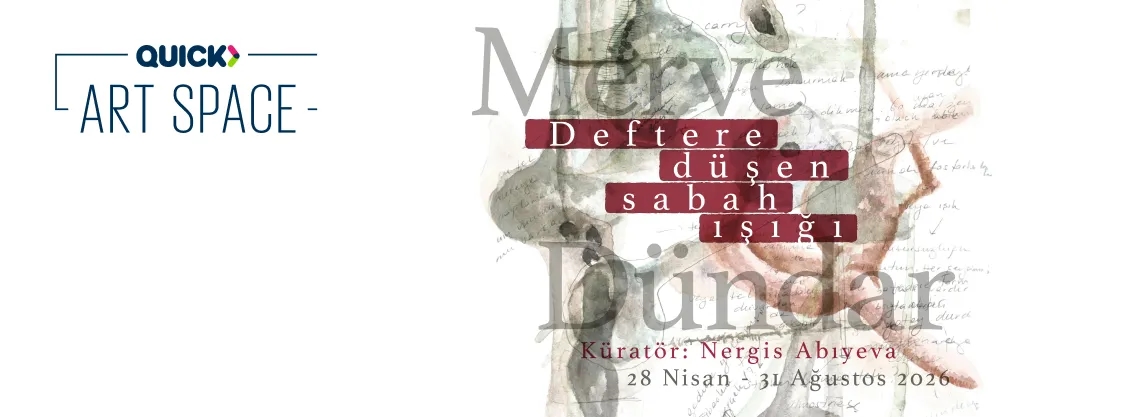
Morning Light Falling on the Notebook
You are invited to the exhibition “Morning Light Falling on the Notebook“
Share
I first encountered Merve Dündar’s practice at the end of 2022, in her exhibition “The Wave in the Mind” at Mixer, and was struck by the universe she constructs through lines, boundaries, and words. Her artistic persona and way of perceiving the world drew me in like a magnet.
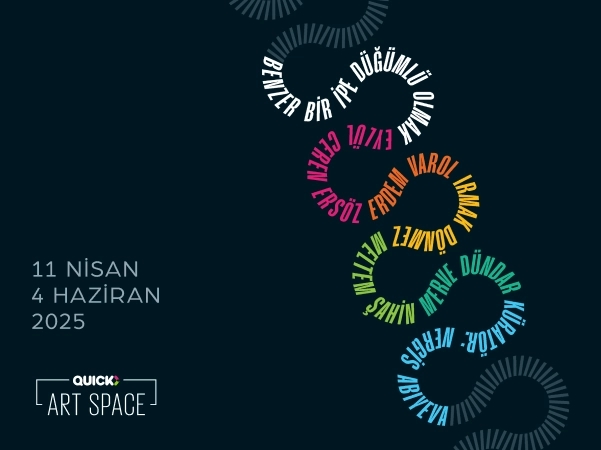
Dündar’s practice unfolds as a process that expands from words to the physical presence of material, and from there toward non-human agents. Working with what she herself describes as “fragile and humble” materials—such as used paper, thread, and chalk dust—the artist produces works with a strong conceptual dimension. For some time, she has been exploring paper in its various forms. We exhibited recent examples of her works, tracing the changing definitions of “woman” and “man” (Legacy: Woman-Legacy Man) in the Turkish Language Association’s dictionary, along with her piece “Erupted” , in which she gives form to words, in the group exhibition “Tightly Knotted to a Similar String” at Quick Art Space last year.
At first glance, one might think that Dündar’s signature lies in her paper-word works constructed by cutting, stitching, and assembling. While this indeed forms one aspect of her practice, her relationship with paper and language is far more complex and layered. Paper undergoes a transformation that moves from the surface of writing toward the texture of material. It gains volume as it turns into paper pulp, accumulates in layers, and generates new forms. In her recent work, Dündar has been researching trees—the primary material of paper—as well as lichens growing on them and the fungus Daldinia concentrica.
As we had decided together while she was still with us, the exhibition “Morning Light Falling on the Notebook” focuses on the transformation of her practice since her last solo exhibition. We also share with the audience her engagement with organic materials and the almost laboratory-like environment she created in her studio. Each time I visited her studio at intervals, I encountered an ever-growing presence of tree barks, trunks, seashells, insects, fungi, and grasses—elements that had gradually become central to her practice. Sometimes encountered by chance during her walks, sometimes deliberately sought out and observed, and later hosted in her studio, these organisms seemed to be waiting for the right moment to become part of her works. When tree trunks were ready to merge with paper pulp, and eggshells and walnut shells to transform into various forms, Dündar’s works would greet me on my next visit with their fragility and transience. As we walked from her studio in Merdivenköy back toward our homes, she would insist on passing through Sahrayıcedid Cemetery, pointing out trees on the verge of decay that, despite having wires run through them, still stood firm, drawing my attention to the Daldinia concentrica growing on them.
Despite its strong conceptual foundation, Merve Dündar’s practice increasingly moves toward an ecological sensitivity. In this sense, it embodies an alchemical attitude that extends from Arte Povera to ecological art and even ecofeminism—an approach that carries within it the cyclical nature of the natural world, as well as processes of dissolution and re-formation. Without abandoning her conceptual framework—on the contrary, by reconstructing it through material processes—Dündar explored the possibilities opened up by working with natural and fragile materials. This shift signals a movement away from representation toward transformation, and from images toward materiality.
For the artist, material is never a fully “obedient” element; on the contrary, it resists, disperses, and at times refuses to transform. The materials used in her recent works carry not only a physical but also a temporal dimension, embodying the possibilities of decay, fragmentation, and re-formation.
The exhibition “Morning Light Falling on the Notebook” pays tribute to the notebooks Dündar returned to in the early hours of the day. We have included some of the notebooks she began filling in the 1980s while sitting in the classrooms of Üsküdar American Academy or attending painting classes at Çizgi Sanatevi during the same period. Like other artists who move beyond considering notebooks as merely a temporary space where thought has yet to take form—where lines and words circulate on the same surface—the lines, drawings, and words that appear in Dündar’s notebooks point to a mode of thinking in their own right. Rather than separating drawing and text, Dündar conceived them as parts of the same flow of thought; her notebooks, in which she took notes and made sketches, form a space that records her everyday observations and mental wanderings. These pages carry not so much a sketch as the traces of thought in motion.
In the exhibition “Morning Light Falling on the Notebook”, we aimed to make visible both the turning points of Dündar’s practice and the processes that remain behind the finished works. As the exhibition continues, we plan to periodically change the notebook pages on display. In doing so, we aim to sustain the openness of Dündar’s works to new possibilities, different juxtapositions, and emerging relationships.
Nergis Abıyeva
Nisan 2026, Erenköy