September 29, 2026
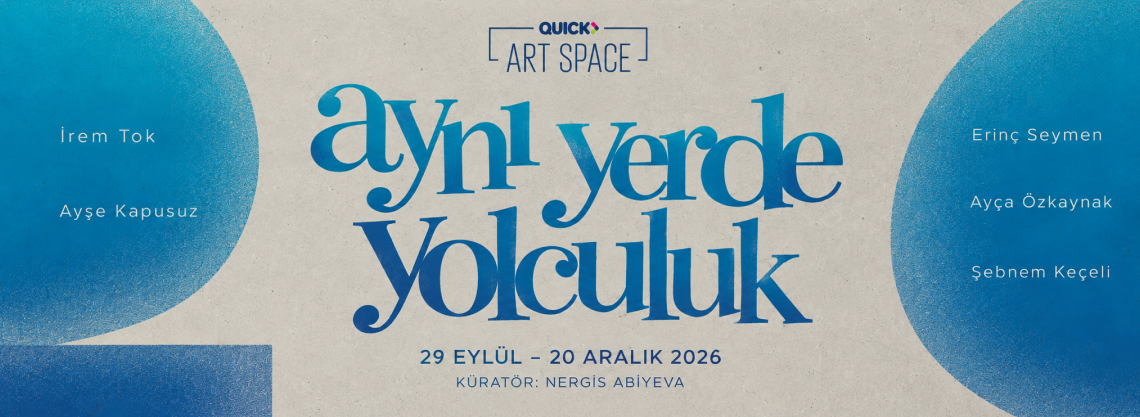
Journey in the Same Place
You are invited to the exhibition “Journey in the Same Place”
Share
Journey without Leaving
When the pandemic struck, the world came to a sudden pause. As movement, contact, and physical encounters were limited, the cadence of everyday life shifted. People finally got around to long-postponed chores; intimidating, thick volumes were finally read against the aroma of sourdough baking in the kitchen.
Alongside this slower, newly calibrated tempo, artistic styles began to mutate. Unable to travel and confined to the same spaces for long periods, many artists were inspired to take a fresh look at overlooked details, everyday life, personal memories, and their immediate surroundings. Others realized they had always inhabited a quiet, introverted world—living as if they were always in isolation.
Looking back today, the pandemic feels almost like a displaced fragment of time. That era—when days blurred together, human touch turned risky, and screens became our primary ways of connecting—occupies a space in our collective memory that is both intensely intimate and strangely remote. Concepts like slowing down, solitude, care, loss, precarity, and resilience quietly permeated our intellectual landscapes and creative output.
“Journey without Leaving” traces the aftereffects of the pandemic across artistic practices. The exhibition brings together five artists who not only produced new work during this period, but fundamentally reshaped their working methods, their relationship to materials, and their modes of perception. Through their work, we aim to illuminate both the pieces forged during isolation and the new directions that emerged in its wake.
Reflecting on the pandemic, one cannot help but recall the haunting lines of Cavafy’s “The City”: “You won’t find a new country, won’t find another shore. This city will always pursue you. You’ll walk the same streets, grow old in the same neighborhoods, turn gray in these same houses. You’ll always end up in this city. Don’t hope for things elsewhere: there’s no ship for you, there’s no road. Now that you’ve wasted your life here, in this small corner, you’ve destroyed it everywhere in the world.”
These lines, which speak to our inescapable bond with the places we inhabit, really hit home during the pandemic. As the world turned inward and our freedom to move was taken away, each of us retreated to our own spaces, confined to four walls. The realization that there was no other shore to escape to merged with mandatory isolation, forcing us to confront our living spaces, our streets, and, above all, ourselves.
Ayça Özkaynak invites viewers into an intimate world through the quiet, contemplative atmosphere of her domestic interiors. She approaches themes of interiority, solitude, and the uncanny through restricted sightlines, framing them around the condition of ‘exposure.’ By drawing attention to details most people pass by without a glance, she prompts us to reconsider what is routinely dismissed as ordinary. In these spaces, the viewer moves between guest and host.
İrem Tok created her series “World of the Invisibles” during the pandemic, and it is being shown for the first time at Quick Art Space. For this project, she collected water samples along her regular walking routes in Kadıköy; from park ponds, puddles, the sea, and street runoff. Looking at these samples under the microscope revealed a whole tiny world full of life, reminding us how little we actually notice around us. To make these see-through organisms visible, scientists use special dyes
There are several Turkish translations of Cavafy’s poem “The City.” The version closest to my reading is by Cevat Çapan.
like methylene blue, which highlight different parts of the cell so they stand out clearly. For Tok, this dye turned from a science tool into a medium for painting, allowing her to bring an invisible world to light.
Tok’s video diptych, “Tension,” features two animations: one figure continuously sinking, while the other struggles to swim upward. These opposite movements show an inner struggle rather than mere physical effort. Suspended between the desire to rise and the pull to sink, the figures inhabit a state of constant imbalance. Rather than telling a fixed story, the work offers an open-ended experience; rising and falling become metaphors for the emotional ups and downs of life, where neither ascent nor descent is ever final.
In “Windy,” Tok addresses the thin line between guiding and being guided. Here, movement is driven by an unseen force with no clear origin. At times, we believe we are moving on our own free will; at others, we are swept along by someone else’s breath. The work invites reflection on control, choice, and relying on others. Breath becomes more than a biological function—it acts as an invisible force, showing the thin line between autonomy and external influence.
Ayşe Kapusuz, who spent the pandemic in Kayaköy, Fethiye, makes these works public for the very first time in this exhibition. The show features paintings, drawings, and sketches created using a variety of media since the pandemic period. Predominantly portraits and self-portraits, these works stand out as highly proficient contemporary interpretations of the Expressionist portrait tradition.
For Kapusuz—who creates art on virtually any surface she comes across, from paper and canvas to notebooks and even napkins—the portrait is less about defining a person or a theme and more a way of seeing them anew.
In her practice, she values what she sees in the exact moment of creation over academic training or acquired knowledge, following spontaneous encounters that unfold during the process. Working with fluid media such as watercolor, ecoline, and ink pens, she makes no attempt to fully control the image. Instead, in a manner reminiscent of stream of consciousness or automatism, she listens closely to what the image itself suggests. Rather than executing a pre-planned composition, she prefers to move forward through the relationships that emerge on the canvas.
Spanning her work from 2019 to 2026, this timeline reaches from the pre-pandemic era to its aftermath—a period that also coincides with her experience of becoming a mother and raising her daughter, Ada. A note on a 2022 painting reading, "I have an issue with time," brings to mind her double shift balancing motherhood and artistic practice. Meanwhile, an entry dated December 2, 2024, found on a page of one of her notebooks included in the exhibition—"Ada painted for the first time today"—reveals the sketchbook as a space where her art notebook and maternal journal seamlessly intertwine.
Erinç Seymen’s digital work “Insured”—created during the pandemic as one of his early steps into digital art—explores our dark fascination with controlled danger. Drawing on cruel shows like circuses and dolphinariums where animals are used for entertainment, the work highlights a dark side of human nature: the thrill of watching animals (and sometimes humans) forced into dangers we'd never face ourselves. For Seymen, “Insured” captures that moment when the fear of risk fades because we know we're safe, and empathy turns into schadenfreude.
Şebnem Keçeli presents seven sculptures started during the pandemic and recently finished.
“Tightness in the Void I-II” (2023–2026) explores the tension between the physical body and the social, cultural, and home life boundaries that enclose it. By combining organic bronze body parts with hard geometric forms, Keçeli shows the home not just as a safe space, but as a place where
close relationships coexist with housework, duty, and traditional roles. While the pandemic made these tensions clearer, the sculptures look beyond that time to show how our bodies are shaped by the seen and unseen rules of daily life.
Keçeli’s “City Dweller” (2021) captures the thin line between urban anxiety and passive acceptance.
The sharp geometry of aluminum melts into the figure’s body, dissolving the line between person and city, while a turned-away glance shows a lasting sense of feeling disconnected. In “Bird City Dweller” (2025), a concrete body holding a metal fork in its beak shows how human environments invade other species. When a kitchen tool becomes a tool for a bird’s survival, it asks who this built environment really belongs to.
The artist’s “Human Condition” (2023) looks at how lives that start with the same basic vulnerability end up taking different paths through identity, belief, and belonging. Sleeping baby faces emerge from dark geometric layers, showing the living form shaped by an order that existed before it. In “Asleep” (2024), geometric masses surrounding a peaceful baby face suggest the invisible traditions passed down through generations, with a subtle silver detail marking this connection. “Passenger”
(2023–2026) explores the weight of inherited forms and the uncertainty of the future. A block of marble supports a soft textured mass, topped only by a pair of tightly clenched toes. Against the silence of stone and fabric, the living detail makes the unseen body feel strongly present.
Ultimately, “Journey without Leaving” views the pandemic not as a past event, but as a period of pausing, reflecting, and seeing things with fresh eyes. Moving beyond simple nostalgia, it invites us to think about the lasting artistic impact of a shared break from normal life. The exhibition rests on the idea that the most meaningful journeys are not outward, but internal, and that sometimes, we can go a long way without ever leaving home.